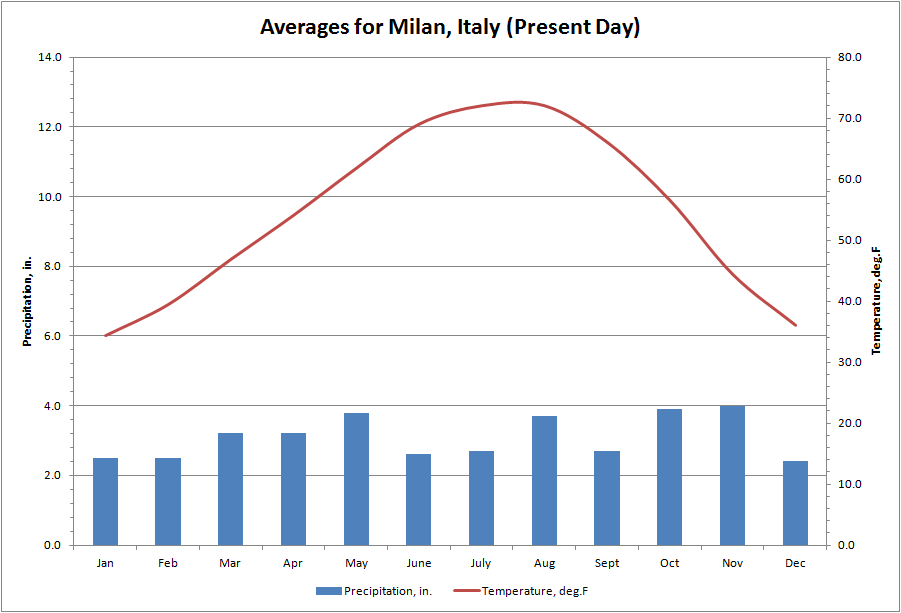
One of the most pressing concerns for human kind today is the Earth climate change and what it means for us in the future. Given that the climate is facing a definite warming of temperatures, it is logical to consider if such changes have ever happened before and what is actually making these changes happen. With a general focus on a specific climate region of Milan, Italy, we will examine 100 million years into the past as well as 100 million years into the future. The information gathered in the time frame of Paleoclimates will help us deduce the forces compelling climate warming today and what these influences mean for future Milan weather.
|
||||
The Past (-100M)
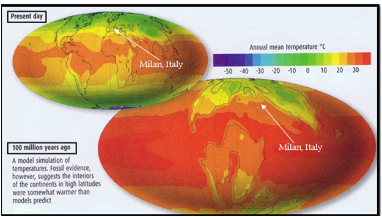 In reference to the
simulated model of 100 million years in the past (above), the Earth's
temperature was 36°F - 72°F (20° - 40° Celsius ) warmer in the polar regions,
although only a few degrees warmer around the equator. Precipitation levels
were 28% greater as well. Evidence suggests that during warm Cretaceous
periods, levels of atmospheric carbon dioxide were high. Models indicate that
carbon dioxide may have been four to six times the pre-industrial levels making
it into a “greenhouse-world”. The levels of Co2 in the atmosphere influenced absorption of incoming and outgoing solar
radiation, warming the entire planet and raising sea level. 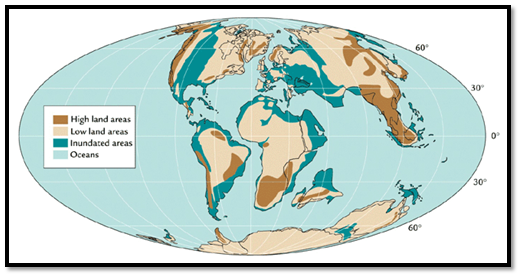
Absence
of the present day Apennines and Alp Ranges in addition to
shallow sea inundation (seen in dark blue) made for a lack of Orographic
effects and coastal local during this time. As aforementioned, these mountain
ranges help to reduce the precipitation in the air caused by the surrounding
waters, acting as a natural climate barrier. Without natural barriers influencing
the weather, Milan most likely experienced a more humid and wet maritime
climate as opposed to the dry and cold climates seen in the rain shadow of Milan’s
present conditions.
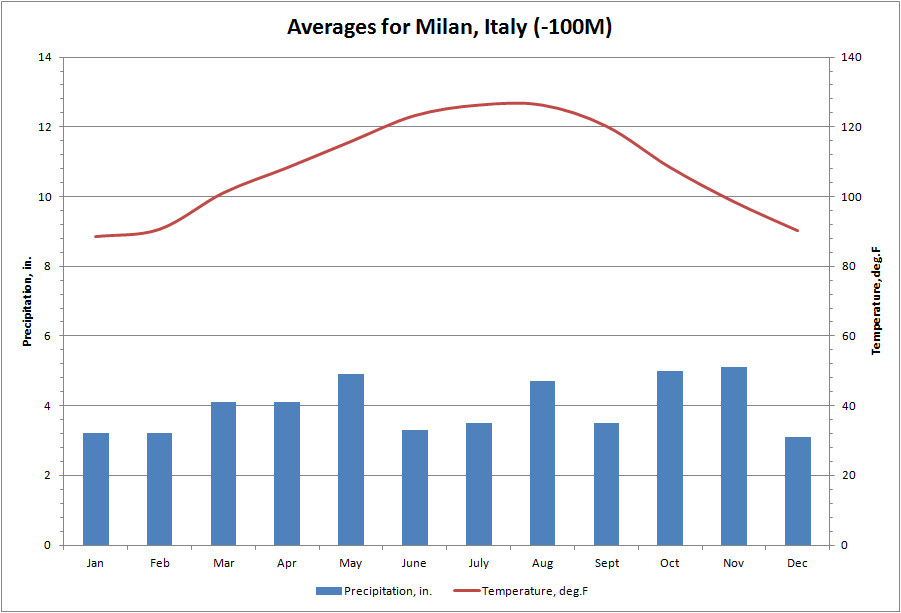
As
seen in the assumed climographs for the Milan region in paleo-climatic times, a
temperature of 54°F (average of the 36°F - 72°F) was added to the average month
to month temperatures seen in present day Milan. For the precipitation levels, I
increased the totally level of precipitation by 28%.
Works Cited: http://www.youtube.com/watch?v=pGACbD4zbWs http://www.cpgeosystems.com/mollglobe.html http://www.youtube.com/watch?v=uGcDed4xVD4&feature=player_embedded http://www.youtube.com/watch?v=devKz2AbdP8 http://history-world.org/stone_age1.htm http://romerica.com/rom/hist_ston_paleo_upper.htm http://earthguide.ucsd.edu/virtualmuseum/climatechange2/07_1.shtml |
The Future (+100M)
Milan’s location
will gradually keep moving in the Northwestern position away from its current
location at 45°27’ N, 9°10’ E to the location of present day Germany at 52°30’ N, 13°25’ E. The predicted change in Milan’s location will alter the
meso and macro scale climate controls. Wind patterns and ocean circulation will
be reflected with such changes. 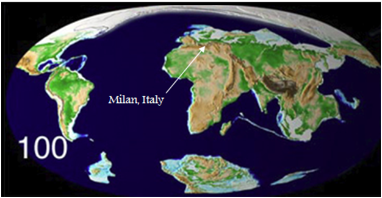
Although the basic causes of climate change are still not fully understood, many clues have been collected to predict the outcome of a 100 million years into Milan future climate view:
According to author of The Big Thaw, Ed Struzik, earth in the future is facing a gradual warming faze. What this means is that, say in a 20 year period, there will be about 15 summers and only 5 winters. The “Tipping Point” is a term Struzik uses to bring relevance to a winter that can no longer keep up with the summer melt. So essentially, summer becomes the dominant force. When summer becomes the dominant force, more ice melts than can be created during the winter time. With a dramatic increase of ice melt, there will be less reflection of the suns solar radiation and greater increase of sea levels around the world (lack of albedo). There will also be less forces moderating climate, gradually warming the planet as a whole. The
present-day Mid-Atlantic Ridge will be subducted and the continents will come
closer together. This will make for a decrease in the inflow of
Maritime Arctic Air and Maritime Polar Air reaching across to Milan. The spreading of
the land masses depicted in the video below ensues the clashing of the African,
Arabian as well as the Eurasian tectonic plates in which Milan will find itself
smacked right in the middle. This
spreading out of the land will result in an intense mountainous and low land
type topography classified today as the Horst/Graben system. As the continents move closer together, the widening of the Atlantic Ocean will have dramatic effects on the future
Milan climate. The width of the Atlantic
Ocean will impose weaker currents in the Gulf Stream as warm water subsides to
warm the water currents toward the Eurasian continents making for a less controlled
climate. All future events described here,
including the effects of a mountainous terrain as well as the lack of climate
regulation on the area will in all probability bring forth an abundant amount
of precipitation and warm temperatures. 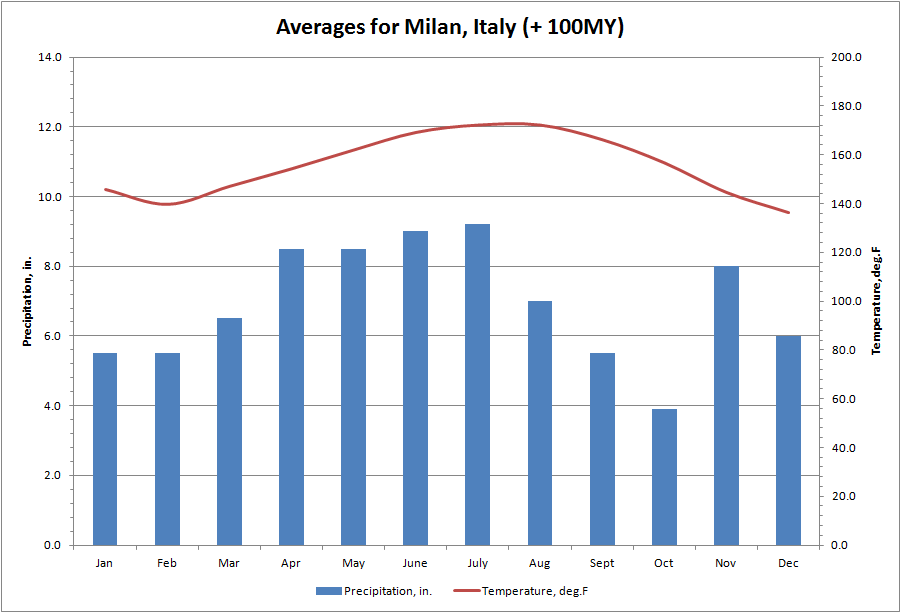 |
|||