Climate Controls Although Europe’s close proximity to the Atlantic Ocean accounts for much of the macro-scale climate variations throughout the land, Milan’s inland position within Italy is effected more on a meso-scale by its location right in the middle of the Mediterranean Sea. The wealth of other seas contained by the Mediterranean (specifically seas that surround Milan, including the Adriatic and Ligurian seas) brings the abundance of precipitation and static temperature variations. As water heats and cools at a much faster rate than land, it accompanies for most of Milan’s Maritime Air masses across the region. A few more meso-scaled climate variations are brought on by the prevalence of Bora winds from the northeast and the Sirocco Winds from the south which are both major factors for wind during the winter seasons of Milan. As previously mentioned in recent posts, Milan is
also at a very close immediacy to two major mountain groups; The Alps to its
North and the Apennines to its West. These mountain ranges help to reduce the precipitation in the air caused by
the surrounding waters, acting as a natural climate barrier. Let us propose
that the summer heating of the Mediterranean Sea resulted in warm currents to
carry clouds abundant with moisture to the northern coast of Italy. As the warm
air rises (Orographic lifting) along the western slopes of the Apennines and mixes with the cold air
at the top, the clouds are stripped of their moisture before reaching the
eastern inland of Milan. This accounts for wet and humid climates on the west
and comparatively dry and cold climates on the east side of the mountain side.
Marian Hala’s Web Cam of Gorgonzola, Italy
(10 mi NE of Milan)
Please view the following ILOMBARD123 weather station Web
Cam recording weather conditions in Gorgonzola, Italy. Unfortunately, there is
no Web Cam for Milan’s weather station; however, Gorgonzola is about 10 miles
Northeast from Milan, making for similar weather conditions. On this ‘Current
24hr’ loop, note that the morning fog rolling in around 7 am. This is a very
constant display of the weather Milan sees on a day to day basis. |
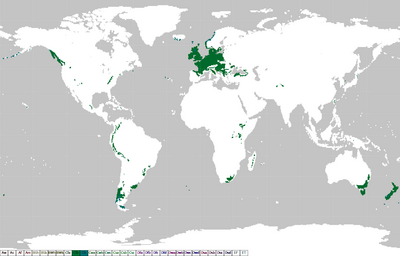
KÖppen – Geiger Climate Classification In accordance to the KÖppen – Geiger Climate Classification system seen in both the map on the left and bottom of this text, Milan falls into a Cfb Climate Scheme which stands for an Oceanic Climate region. An Oceanic Climate is also known as maritime west coastal climate, maritime climate, Cascadian Climate and British Climate. This climate region generally features warm, but not hot summers and cool, but not cold winters, with a narrow annual temperature range.
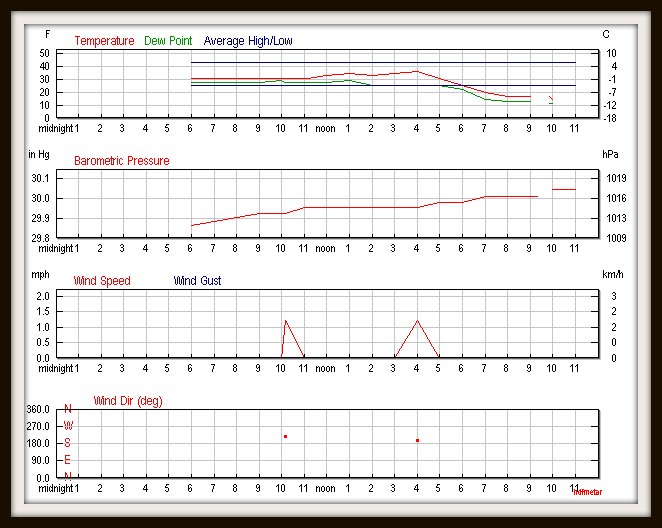
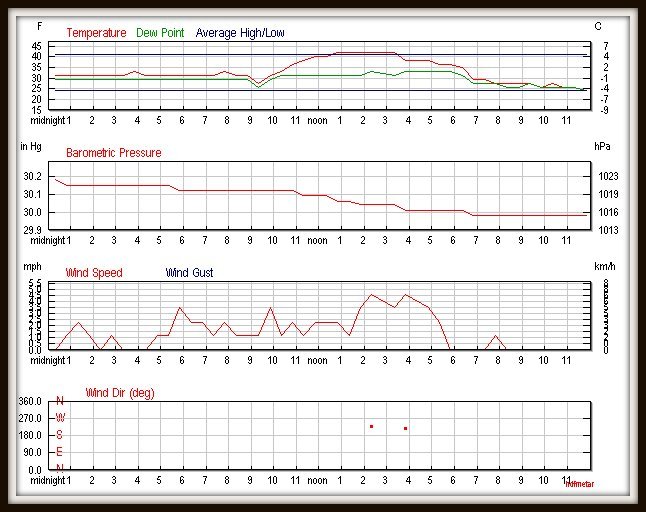
 On a more localized level, a few micro-scaled climate variations are proposed by both Orographic and Anthropogenic conditions. Some Orographic, or naturally occurring climates, are seen at the first reliefs of the Alps where temperatures are subject to cold air. Italy’s gradual temperature increase, as seen in the charts pulled from the IMILAN13 below, indicate large-scale weather patterns uniformly influencing temperature. The ongoing temperature and humidity increases from west to east are believed to not be related to circulation patterns but to the non-uniform water vapor feedback caused by anthropogenic activities throughout the cities of Europe. Surface radiation measurements marked anthropogenic greenhouse forces and strong water vapor feedback giving way to temperature rise. Milan’s weather station, as
depicted in the graphs below, goes back to 1997. With reference to January 1st,
1997 to January 1st, 2011 the following information is listed;
Works Cited: (PLEASE CLICK ON THE IMAGES TO BE DIRECTED TO THEIR APPROPRIATE SITES) http://www.itas.fzk.de/eng/infum/gch_EUR.htm http://en.wikipedia.org/wiki/Rain_shadow http://www.clrsearch.com/Milan_Demographics/IL/Population-by-Age http://www.agu.org/pubs/crossref/2005/2005GL023624.shtml
|